Everett Gaius S. Vergara
FYD Technologies OPC

Everett Gaius S. Vergara is a software engineer with more than two decades of experience designing, developing, and implementing business-critical software systems across a wide range of industries. As Chief Technology Officer of FYD Technologies OPC, he leads the company's technical direction with a focus on building systems that are reliable, scalable, and engineered for long-term performance.
His expertise lies in the design and development of low-level, low-latency software systems, primarily using C++, where performance, efficiency, and predictability are fundamental requirements. He has spent much of his career working close to the operating system, hardware interfaces, communication protocols, and performance-critical execution paths, developing software that must operate with minimal overhead and maximum reliability.
Throughout his career, Everett has been involved in the architecture and implementation of a diverse portfolio of systems, including Enterprise Resource Planning (ERP) platforms, manufacturing and inventory systems, logistics solutions, financial applications, customer engagement platforms, computer vision systems, telecommunications software, and business process automation tools. His experience spans the full software lifecycle, from requirements analysis and solution architecture to deployment, optimization, and long-term operational support.
Performance engineering remains at the core of his technical practice. He is known for analyzing complex systems from first principles, identifying bottlenecks at both the software and architectural levels, and delivering solutions that maximize throughput while minimizing resource consumption. Whether optimizing database operations, designing real-time processing pipelines, integrating with hardware devices, or building distributed business systems, his focus remains the same: achieving the highest level of performance without sacrificing maintainability or correctness.
Beyond software development, Everett has led the successful implementation of enterprise systems across multiple industries, translating business requirements into practical technical solutions that deliver measurable operational value. His work bridges the gap between deep technical engineering and real-world business execution, ensuring that technology serves a clear operational purpose rather than becoming an end in itself.
At FYD Technologies, he promotes an engineering culture centered on technical excellence, disciplined execution, and pragmatic problem-solving. Complexity is treated as a cost, performance as a feature, and simplicity as the foundation of systems that can scale and endure. The result is software engineered not only to solve today's problems, but to remain effective and maintainable for years to come.
Systems & Low-Level Programming
Deep expertise in C and C++ spanning embedded systems, OS-level programming, memory management, and hardware-adjacent software. Comfortable working close to the metal where most developers stop.
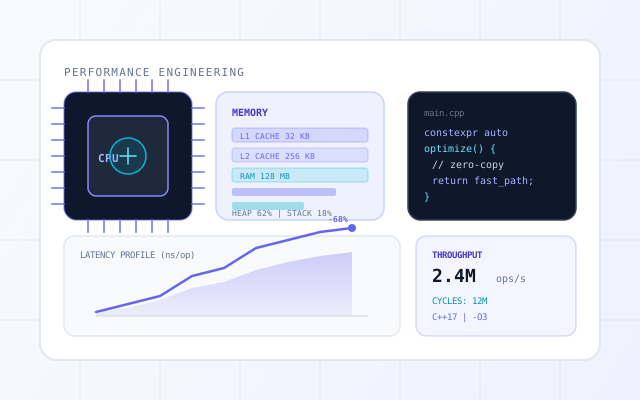
Performance Engineering
Obsessive about execution speed and resource efficiency. Specializes in profiling, bottleneck elimination, algorithmic optimization, and squeezing maximum throughput from constrained hardware and tight latency budgets.
Computer Vision Pipelines
Designs and implements high-performance vision processing pipelines — from frame acquisition and preprocessing to inference and real-time output. Focused on accuracy, speed, and deployability in production environments.
Architecture & System Design
Architects software systems from first principles — choosing the right abstraction level, data structures, and execution model for each problem domain. No over-engineering; no under-engineering.
Optimization & Benchmarking
Rigorous, data-driven approach to performance improvement. Uses profiling tools, micro-benchmarks, and hardware performance counters to make decisions backed by measurement, not intuition.
Primary Language
Secondary Languages
Databases
Domains
C++ Standards
Compilers & Toolchains
Debugging & Profiling
Libraries & Frameworks
AI Systems Architecture
- LLM integration & orchestration
- On-device inference pipelines
- AI-assisted workflow automation
- Model deployment & optimization
- RAG and vector store design
Enterprise Business Systems
- Full-cycle ERP implementation
- Large-scale accounting platforms
- Financial ledger systems
- Multi-entity business logic
- Payroll & HR systems integration
- Inventory & supply chain modules
System Integration
- Legacy system migration
- API design for enterprise scale
- Multi-database orchestration
- Third-party ERP connectors
- Cross-platform data pipelines
Measure, Then Optimize
Never guess. Profile first, identify the real bottleneck, and fix what actually matters.
Complexity is Debt
Every abstraction layer has a cost. The best architecture is the one that does exactly what's needed — nothing more.
Speed is a Feature
Performance is not an afterthought. A fast, reliable system is a product differentiator in its own right.